
How a chalet is drawn
Window Seat has no picture files for its scenery: no PNGs, no SVGs, no photos. Every building, tree and cloud is a short program that draws it from simple shapes as the train reaches it. That's what lets the world change with the season, light its windows at night, and never repeat.
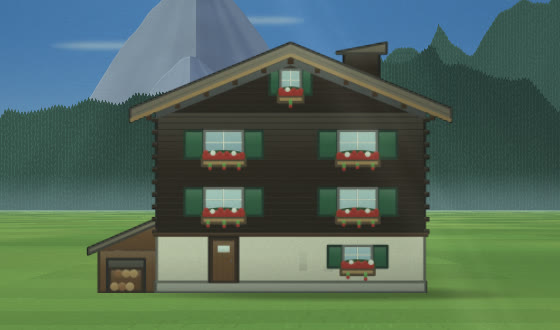
// 2. Ground floor, timber (or plastered) storeys.
if p.ground == .stone {
    AlpsArch.wall(&s, AlpsWallLook(mat: .stone, ink: g.chance(0.7) ? ALInk.granite : ALInk.lightStone, wear: p.wear), 0, W, 0, groundH, &g)
} else {
    AlpsArch.base(&s, -0.05, W + 0.05, 0.45, &g)
    AlpsArch.wall(&s, AlpsWallLook(mat: .plaster, ink: g.chance(0.6) ? 10 : ALInk.plasterCream, wear: p.wear), 0, W, 0.45, groundH, &g)
}
if wallTop > groundH + 0.2 { AlpsArch.wall(&s, clad, 0, W, groundH, wallTop, &g, corners: clad.mat == .logs) }
s.hline("sill beam", .wood, -0.15, W + 0.15, groundH, 0.16, ink: p.cladding == .plaster ? wk : ALInk.woodDark)

// 3. Ground floor openings: the door in one column, small windows in the others.
let cols = Self.columns(W, p.rhythm)
let groundCols = p.rhythm == .ribbon ? Self.columns(W, .even) : cols
let doorCol = g.int(0, groundCols.count - 1)
let gy = p.ground == .stone ? 0.05 : 0.45
var ground = style; ground.slats = false
for (i, c) in groundCols.enumerated() {
    if i == doorCol {
        AlpsArch.door(&s, c.x - 0.5, gy, 1.0, min(2.05, groundH - gy - 0.2), lit: g.chance(p.lit), &g, ink: ALInk.woodAged,
                      arched: p.ground == .stone && g.chance(0.4), anchor: true)
    } else {
        let w = min(c.w, 1.2)
        AlpsArch.window(&s, c.x - w / 2, 1.05, w, min(0.9, groundH - 1.35), lit: g.chance(p.lit), &g, boxed(ground, share * 0.5))
    }
}AlpsChalet.swift: the stone or plastered ground floor, the timber storeys above, and where the door and windows go.One recipe, many chalets
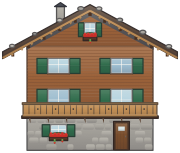
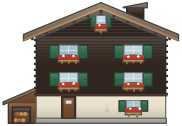
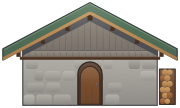
The same code makes every chalet on the line. Each one rolls its own choices: which way it faces, how many floors, the wood, the roof, the shutters, a woodshed or a barn, flower boxes that bloom with the season.

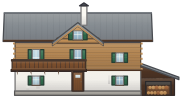
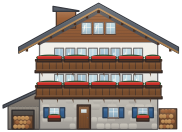
let vocabulary = Vocab()
    .c("view", View.self).c("wood", Wood.self).c("ground", Ground.self).c("cladding", Cladding.self)
    .c("roof", AlpsRoofKnob.self).c("shutters", AlpsShutter.self).c("annex", Annex.self).c("balconyAt", BalconyAt.self)
    .c("rhythm", Rhythm.self)
    .yn("stones", "carved", "boxes", "woodpile", "chimney", "dormer")
    .r("balconies", 0, 2).r("floors", 1, 3).r("width", 7, 16).r("slope", 0.28, 0.8).r("eave", 0.9, 2.2).r("wear", 0, 1).r("lit", 0, 1)
.buildWho made it
- The drawing code was written with an AI coding assistant (Claude), directed and reviewed by me. No image-generation model was used.
- The look comes from the code's own vocabulary of shapes: walls, beams, shutters, window boxes. That's why it reads as a simple drawn style rather than an illustration.
Where does the AI's sense of a chalet come from?
Honestly, both from art and not. I can't see Claude's training data, but it's trained on a huge amount of text and images: writing about architecture (Kniestock, Quergiebel and the half-hip roof in this code are real Alpine building terms), travel writing and photos, drawing tutorials, and a lot of graphics code. Art made by people is in there too. So its sense of what a chalet looks like comes from people's work, mostly people describing, photographing and building real chalets, and some of them artists.
What it didn't do: it didn't look up an illustration and trace it, and no image model produced pixels. It wrote a recipe in terms of walls, beams, windows and flower boxes, the way someone who has seen a lot of chalets could describe one to a draughtsman. Then the work was a loop: render it, look at it, critique it against my notes ("too regular", "two neighbours look alike"), adjust the code. Much of the look comes from that loop and from the vocabulary of building blocks it grew over the weeks, which is why it has a consistent, slightly plain drawn style rather than any particular artist's.
So it sits somewhere between copying art and inventing from nothing: closer to a person drawing from memory, except the memory came from training on other people's work. That's why "yes and no" is the honest answer to whether AI made the art.
Josh Lannin, developer of Window Seat